

An Israeli study titled ‘Detection of Pfizer BioNTech Messenger RNA COVID-19 Vaccine in Human Blood, Placenta and Semen’ was published by Gavin Publishers mid October 2025 and made headlines in independent media.
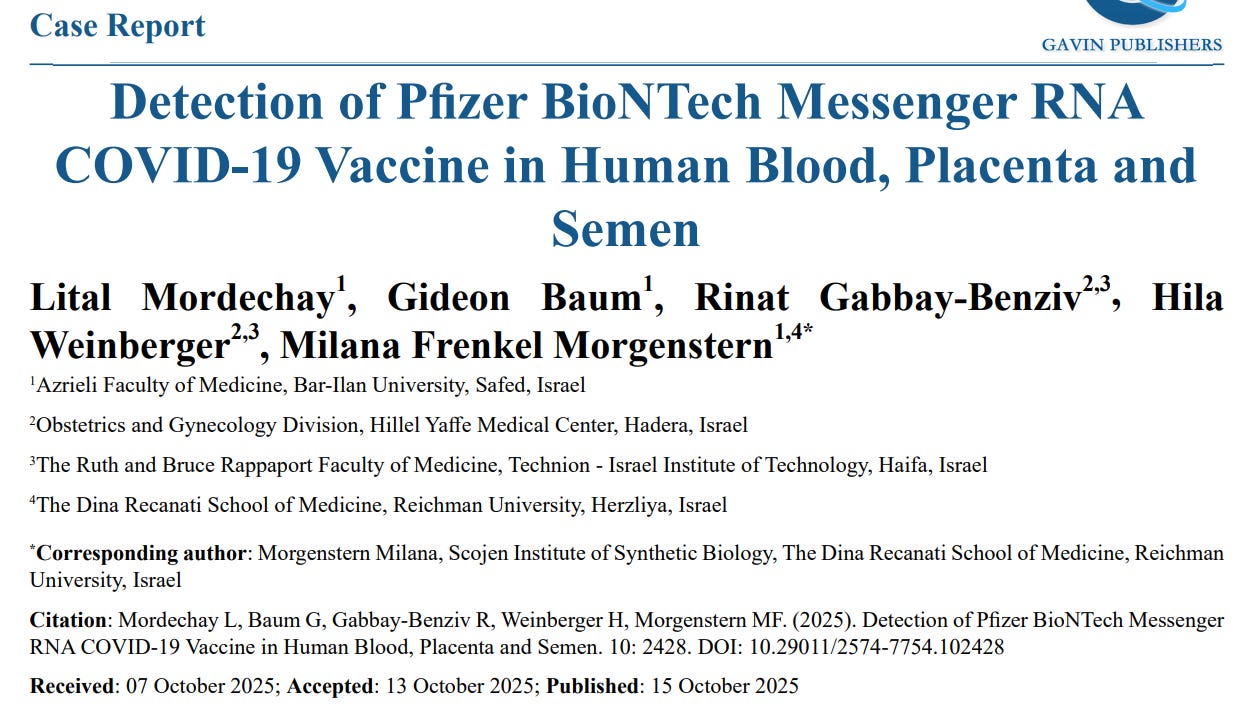
However, the paper didn’t see the light of day for long. In early December it vanished. It was not retracted, it just quietly disappeared without any explanation whatsoever.

Luckily, before the paper disappeared, Tom Haviland printed it out.
After my interview with Haviland, I discovered the paper on the Wayback machine as an archived snapshot from December 5, 2025, shortly before it disappeared:
Despite the article being listed in 2025, Gavin Publishers does not include it in its Case Reports archive. There is no retraction notice on site.
Gavin Publishers allow withdrawal of articles post-publication but require an explanation why the article was withdrawn. However, as already stated, no explanation was given. And it’s not clear that the article was in fact withdrawn by its authors. Or whether some higher authority ordered it to be removed.
Papers don’t just disappear. If they quietly vanish without explanation, it stands to reason that their findings are intentionally suppressed.
Purpose of the Study
The study’s purpose was to determine for how long synthetic mRNA from the Covid-19 vaccine Comirnaty (Pfizer’s vaccine) could be found in the blood, placenta, sperm and seminal fluid of vaccinated people and whether traces of synthetic mRNA from the Covid shots might also be found in unvaccinated people.
The 34 participants consisted of 22 pregnant women, four male patients from a fertility clinic and eight additional people.
Twenty-four out of the 34 participants were vaccinated with the Pfizer vaccine and one of them with the Russian Sputnik vaccine (which is not an mRNA vaccine).
Ten participants were unvaccinated and six of those were pregnant women.
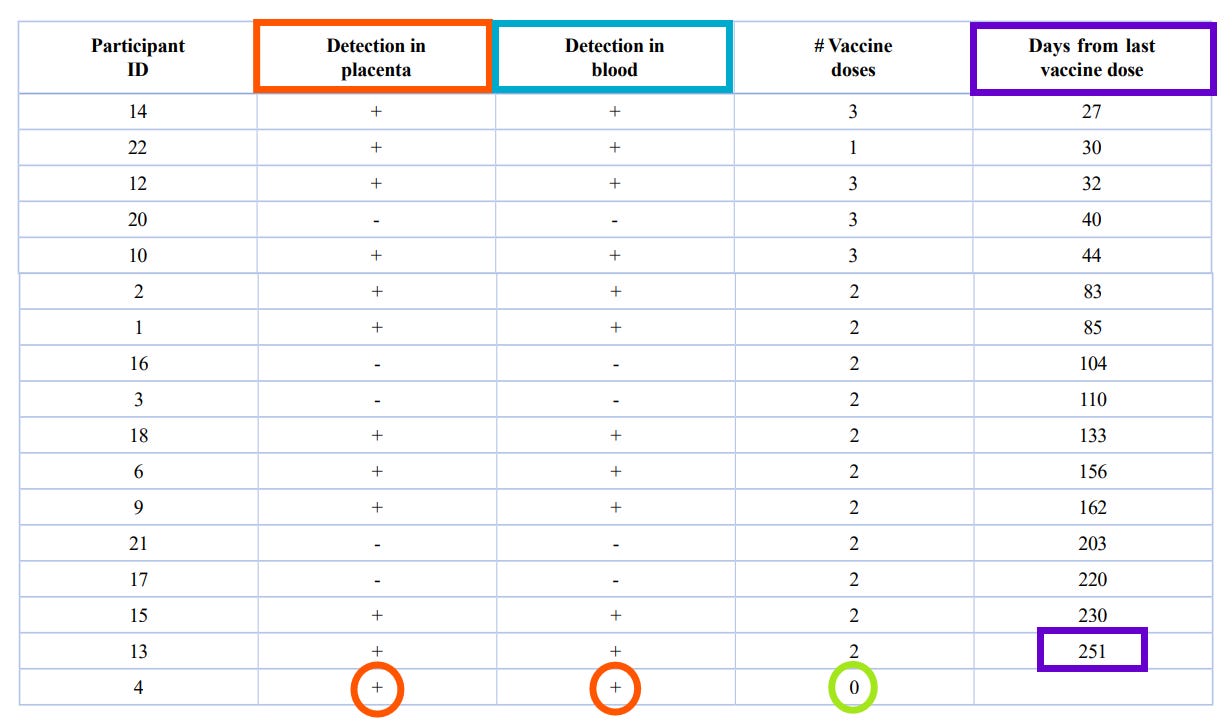
Out of the 22 pregnant women, 16 had received between 1 and 3 mRNA Covid shots.
Samples From the Pregnant Vaccinated Women Were Collected in 2020 (!) and 2021
What remains unmentioned in the abstract of the paper and is only revealed at close reading, is the astonishing fact that at least sixteen of the samples were not collected in 2025 as I had first assumed, but about 5 years earlier, from December 2020 until about the summer of 2021.
In other words, they started sampling the first participants as soon as the mRNA Covid shots were deployed in Israel.
In fact, there is only one instance in the entire paper telling the reader when the samples were taken and that instance mentions only the 16 pregnant women who had received the vaccine:
“We studied 16 pregnant women who received Comirnaty COVID-19 (Pfizer-BioNTech) vaccine during pregnancy between December, 2020 and September, 2021.”
In Israel, pregnant women could get Pfizer’s Covid shot from the very beginning, since rollout in December 2020, if they wanted to.
In January 2021, Israel’s Ministry of Health recommended vaccinating pregnant women in the second and third trimester. At that same time, the ministry also recommended women to get the shot when planning pregnancies and while breastfeeding.
In fact, there is only one instance in the entire paper telling the reader when the samples were taken and that instance mentions only the 16 pregnant women who had received the shots:
“We studied 16 pregnant women who received Comirnaty COVID-19 (Pfizer-BioNTech) vaccine during pregnancy between December, 2020 and September, 2021.”
Perhaps the samples from the six additional pregnant women that were unvaccinated were also taken during the same time window but we don’t know.
It’s also unclear when the samples of the male patients from the fertility clinic were taken and those of the eight additional ‘general population’ people.
This is bizarre to say the least. Given that the paper was submitted, accepted and published in October of 2025, readers would naturally assume, as I did, that the study was done recently and not five years ago:
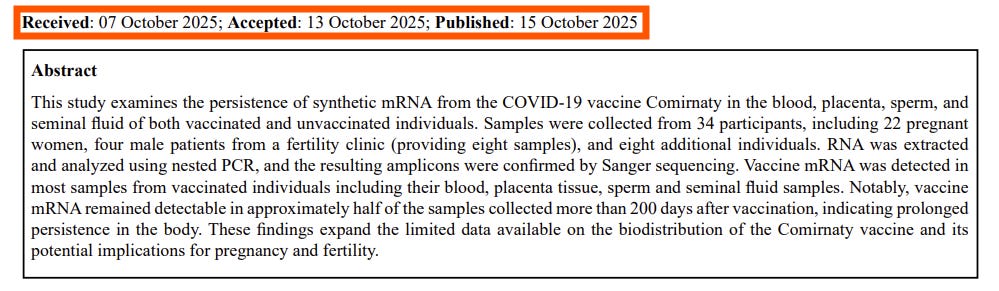
It stands to reason that the scientists not only took the samples in 2020/2021 but also analyzed them at the same time.
Which would mean that they were sitting for 5 years on the devastating results they were able to publish, but only briefly, in late 2025.
The Nested PCR Test
To analyze the samples for the existence of synthetic mRNA from the Covid vaccine, the scientists used a technique called ‘nested PCR’ test. This test allows the detection of even the minutest amounts of mRNA. But it carries the risk of false positives if the test is not done carefully and rigorously. The contamination risk of samples, for example, is higher than in the non-nested PCR test.
That’s why it is important to confirm results by sequencing, which is what they did: “RNA was extracted and analyzed using nested PCR, and the resulting amplicons were confirmed by Sanger sequencing.”
Synthetic mRNA Is Found Not Only in the Vaccinated But also in the Unvaccinated
The study detected Pfizer BioNTech Messenger RNA Covid-19 Vaccine in 20 of the 24 vaccinated participants, 83%.
Out of the 16 vaccinated pregnant women, synthetic mRNA was detected in the blood as well as in the placenta of eleven of them, 69%. In fact, there isn’t a single case of a pregnant woman who received the shot during pregnancy, where mRNA showed up only in the blood and not in the placenta.
In three of the six unvaccinated pregnant women, synthetic mRNA was found in the blood. In two of those three, synthetic mRNA was also found in the placenta.
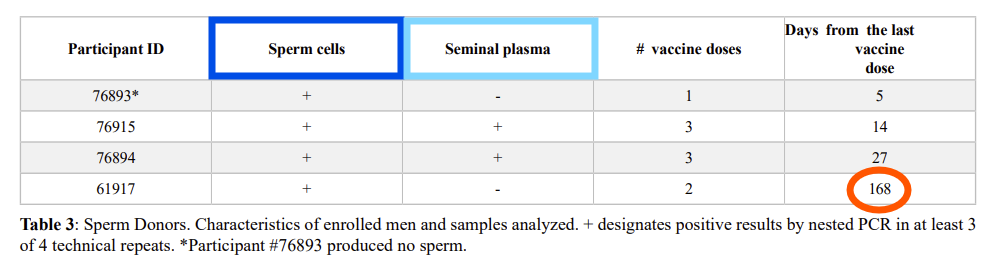
All four male participants from the fertility clinic had synthetic mRNA either in their sperm and/or seminal fluid. Two of them had mRNA in both sperm and seminal fluid and the other two only in sperm.
The study also showed the persistence of the synthetic mRNA in the human body. Messenger RNA remained detectable for longer than 200 days in about half the samples.
Findings For Pregnant Women
The table below shows the results for pregnant women who had received 1 to 3 of Pfizer’s mRNA Covid shots with the exception of the participant in the bottom row, participant 4, who was unvaccinated.
And below are the results for the other five unvaccinated, pregnant women.
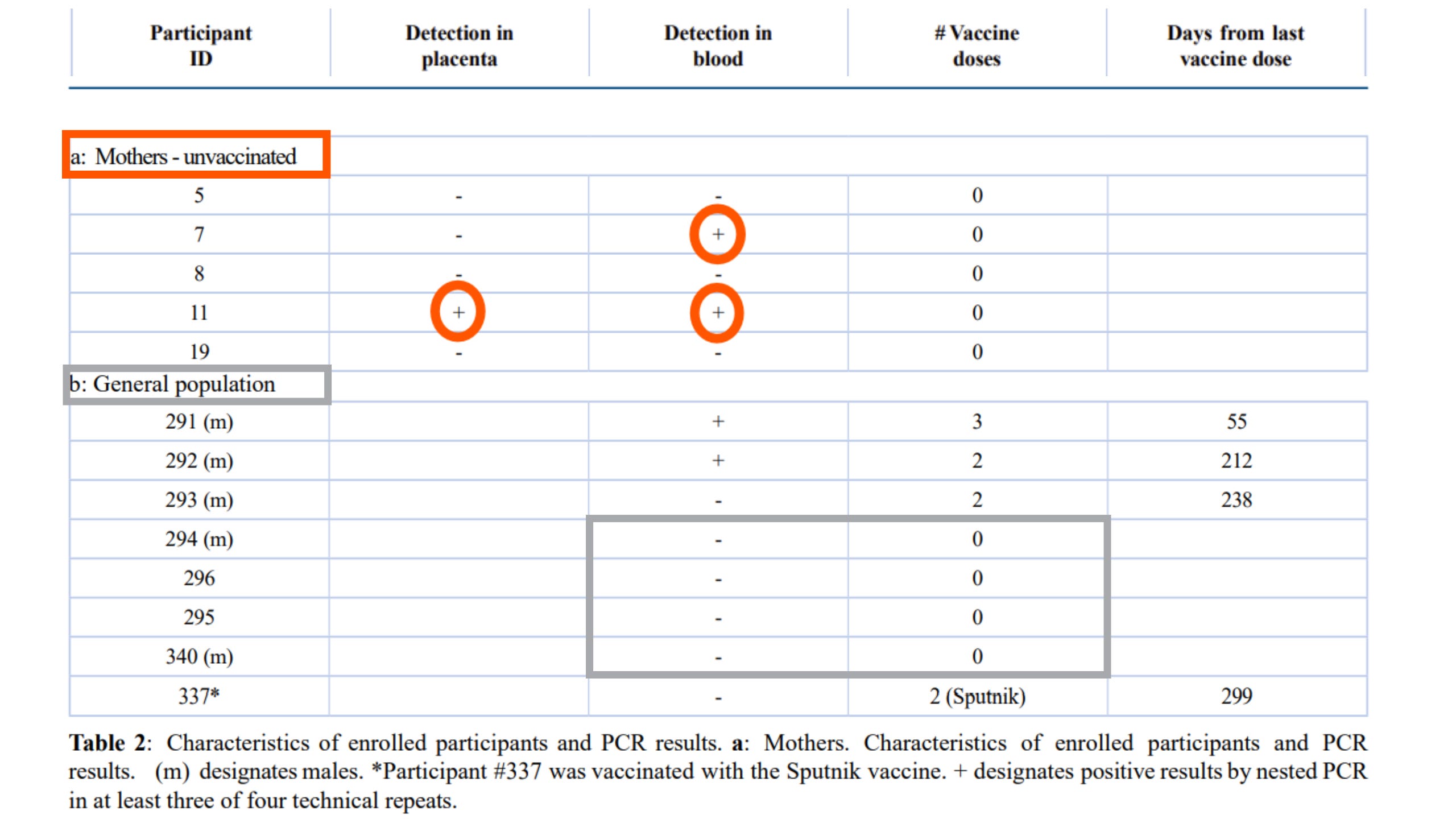
Synthetic mRNA was discovered in the placentas of two of them
In three of them it was discovered in the blood.
In two of the women, mRNA was found in both placenta and blood.
What’s interesting is that, in contrast to the unvaccinated pregnant women, no traces of mRNA were discovered in the blood of the four unvaccinated participants from the ‘general population.’
Messenger RNA Persistence in Sperm and Seminal Fluid
Below are the results for the four men from the fertility clinic.
In one case, the last vaccine dose had been received 169 days before the sperm and seminal fluid samples were taken.
If you want to read the paper yourself, here is the link to the Wayback machine where it now resides after it was withdrawn from Gavin Publishers:
CHAPTERS
0:00:56 Article Removal and Initial Reactions
0:01:57 Study Overview and Israeli Vaccination Context
0:04:27 Early Findings on mRNA Persistence
0:06:37 Groundbreaking Detection in Placenta
0:07:36 Nested PCR Method Explanation
0:10:29 Sample Collection Timeline
0:12:28 Delays in Publication and Data Analysis
0:15:31 Lipid Nanoparticles and Systemic Distribution
0:18:28 Detection Rates by Time Since Vaccination
0:23:33 Shedding Hypothesis and Children’s Mortality Analysis
0:27:20 Vaccination Timing and Pregnancy Outcomes
0:32:07 mRNA Presence in Male Reproductive Cells
0:36:17 Correlation of Detection with Days Since Last Dose
0:37:04 Discussion: Transplacental Transfer and Limitations
0:40:15 Unusual Fetal Deaths and Placental Issues
0:41:07 PCR Method Limitations and Need for Further Research

